4. Rule of Communication 🗣️
Building a satisfying relationship with your customers and team members is not easy. Especially for those of us who work in an environment that depends on many factors, such as workload, personal problems at the time, weather, and environment. Therefore, the following guidelines provide the basic guidelines necessary for successful communication with customers and team members.
Why is tone important?
In 1967, Albert Mihrabian came up with the "7%-38%-55%" rule of thumb for communication.
- Words you use (7%),
- The tone of your voice (38%), and
- Body language that accompanies your words and voice (55%).
When erxes team members communicate with others, we aim to be proud, responsible, caring, clear, concise, and humane.
Proud – Our goal is to create experiences that help users solve their problems. We need to articulate this goal and its implications in the right way. For example, instead of saying, "Unfortunately, we have to pay," it's better to say, "We have a small service fee of X% to keep erxes running."
Accountability – If something goes wrong and your customer or team member is disappointed or disappointed, it's on us. There's no need to blame someone (eg, "Our engineering team screwed up this job") or make excuses. Instead, we need to realize our mistakes and move forward together.
Compassionate – We acknowledge and understand our customers' emotions and aim to base every conversation on them. That means we adjust the tone of their voice and the situation as much as we can.
Understandable – While it's okay to use personal expressions, emojis (from time to time) and exclamation marks when interacting with customers, using typos, incorrect punctuation, commas, poor wording or missing the point of a question can make us look unprofessional. is It may seem obvious, but when building a tall building, a good foundation is essential.
Clear – No matter how many fun conversations you have with a customer, never forget why you connected. Our job is to fully understand their needs and solve them as quickly as possible. Therefore, if possible, if possible, number the important things to remember and ask, and mark them with key words or each idea within 2-4 sentences, so that meetings and interviews can be more effective, concise and clear.
Humane – Even if you're using an answering machine, we want our clients to know that we're human, just like you. Even if it's a clichéd response, try this trick to connect more with your customer: Avoid using words you wouldn't use in a casual conversation when interacting with a customer.
Our tone of voice guidelines Communicate with customers in the same way you would normally speak. Be yourself when talking to customers. Acting like you're talking to a parent or grandparent can help you find the right tone.
Keep it simple, unless you're delivering bad news.
Emojis: Great for positive communication with customers.
Spoken language or “text talk”: Avoid using abbrevations and slangs like lol, hmu, hbu. We need to be more professional.
Exclamation mark: Use only 1 to 2 maximum for each answer. Use only when the overall content of the response is very positive.
Let's take a look at the Zendek survey.
According to a survey conducted by the "Software Advice" company, 65% of customers preferred a "simple" tone of communication with their support staff.
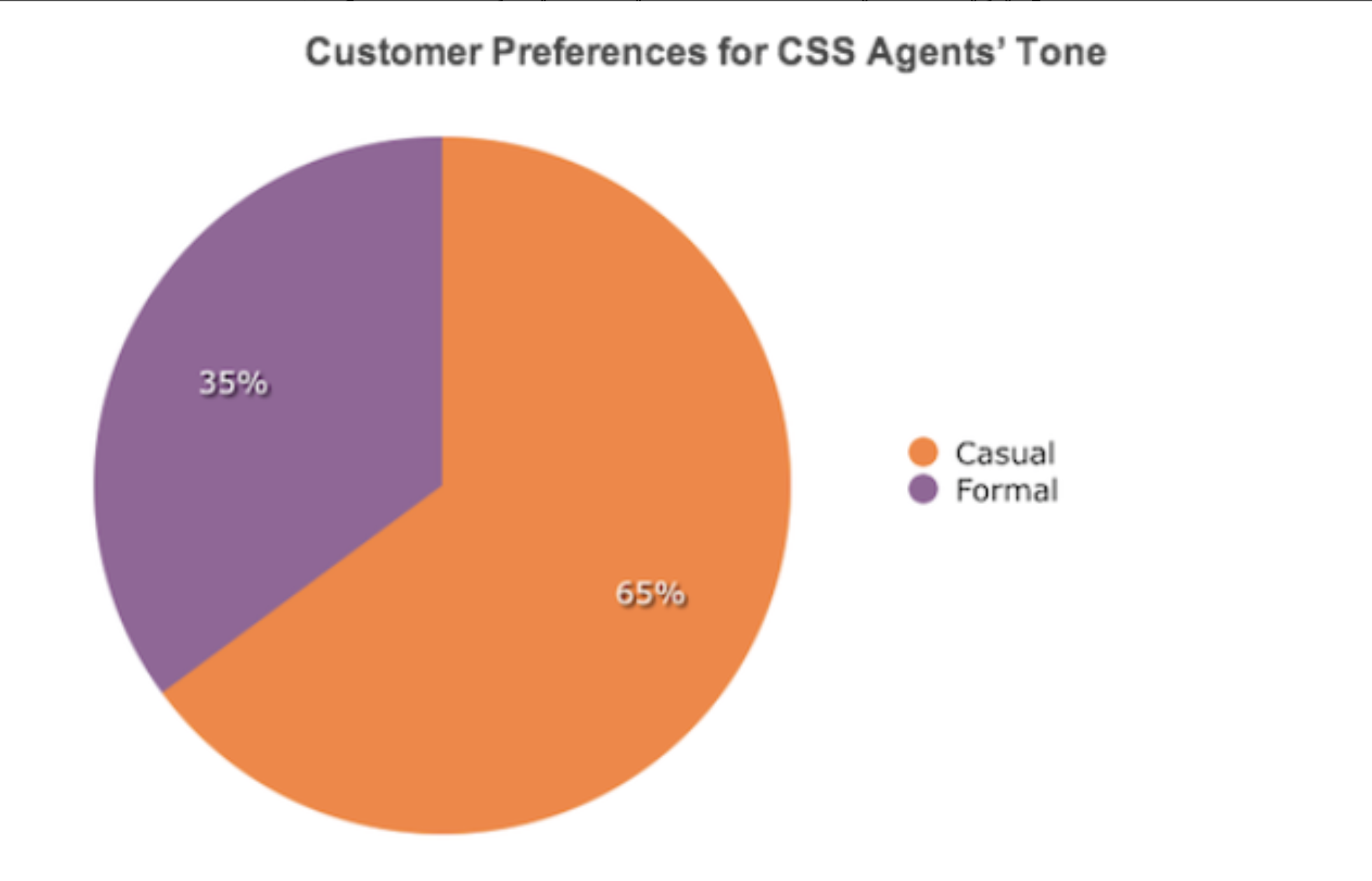
Interestingly, in terms of prevalence, this was observed across all age and gender demographics. No matter how young or how old the customer is, they usually prefer simple tones and styles.
Context matters
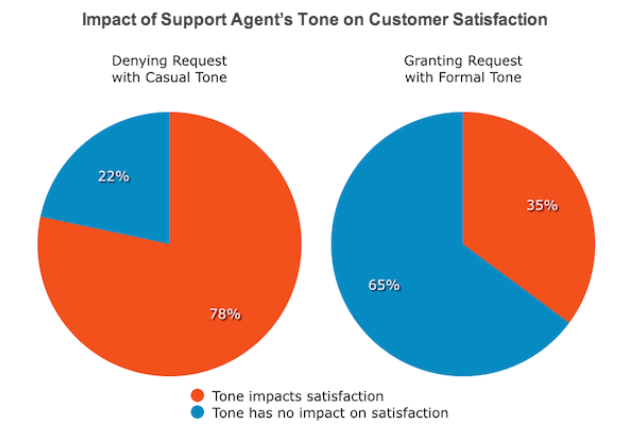
Although most people prefer a more humane and friendly tone, whether or not this is conducive to your relationship can vary depending on the situation. But as a service employee, he must be able to assess the situation and any emotion, and respond in the right way and appropriately.
For example, according to Jay Ivey, clients may be more likely to interpret simple conversations and attitudes as insensitive, degrading, or otherwise inappropriate when they are vulnerable and emotionally charged. Therefore, it does not depend on you alone.
Expert advice:
A support worker should be careful when dealing with angry or upset people. These clients understandably pick up on the tone of the conversation more sensitively, so it's best to tone down the conversation, try other techniques to defuse the situation, and create a more productive environment.
Some of the expressions are sometimes really inappropriate
A simple joke can sometimes go too far. Yes, this is common, especially if the speaker or writer representing your executive or company is naturally funny, and the entertainer may have a soothing charm.
In the past decade, emoticons [ ;P ], emojis, and colloquialisms ["hehe") have become increasingly popular in digital communication. They add character to a sentence or story you're telling, but is it something that will impress every reader?
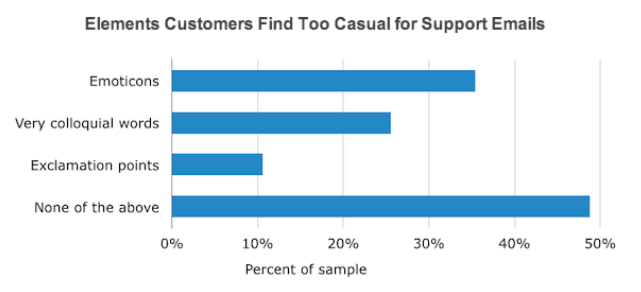
49% of users don't think any of the above emoticons, colloquialisms, or warning signs are too simple, while 35% think emojis are too informal to encourage emotion. Similarly, 26% rated spoken words according to the following criteria.
But Jay Ivy has a caveat. Unlike e-mail, live chat conveys more simplicity. It's easy to give a quick chat response to remind the other party that you're dealing with a real person. Sometimes it's actually okay to use emoticons or colloquialisms freely when texting, but you should always be aware of how you're communicating with the other end users and what their needs are.
Expert advice:
Read the situation. If your customer uses emoticons and colloquialisms, it's usually okay to respond using them. But don't cross the line and treat it like a bad Twitter post.
The character of the story you're telling: Being attentive and alert to your client's feelings and context will in turn help you use the right expressions and word choices. Determining the context and vocabulary that prompts these conversations will go a long way in getting the main communication message across. Things to consider when communicating with clients and team members:
- Use the name- Don't call them Sir/Ma'am or Mr/Mrs
- Always use greetings.
Start: Hello? Or How are you?
End: Good luck or Thank you
- Express your appreciation to them when appropriate, especially when they first interact.
Give Feedback: Thank you for contacting us.
Don't use it for every one of their answers; otherwise it will feel too scripted and contrived.
To apologize when necessary
- We apologize for the trouble you are experiencing.
- Write without grammar, spelling, or composition problems
- Use the necessary applications to avoid making any mistakes
- Regularly review your email and correspondence with direct control
Be positive.
- This is a great question!
- Start with the good, not the bad.
- Use "we" not "I". Remember that every email you send is on behalf of your company.